Showing posts with label meaning. Show all posts

Sunday, 10 March 2013

Am I A Dishonest Atheist?

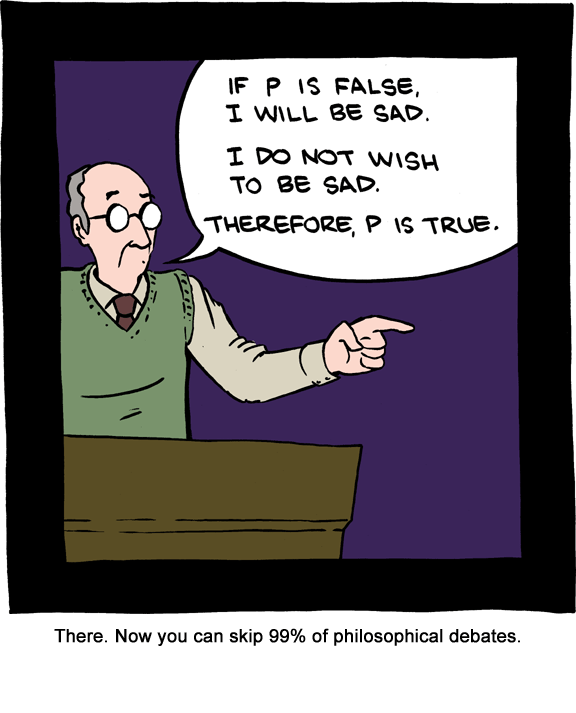
If atheism is true, it is far from being good news. Learning that we’re alone in the universe, that no one hears or answers our prayers, that humanity is entirely the product of random events, that we have no more intrinsic dignity than non-human and even non-animate clumps of matter, that we face certain annihilation in death, that our sufferings are ultimately pointless, that our lives and loves do not at all matter in a larger sense, that those who commit horrific evils and elude human punishment get away with their crimes scot free — all of this (and much more) is utterly tragic.
The above quote is taken from a review of A.C. Grayling's The God Argument written by Damon Linker. I've heard this sentiment expressed often enough, yet I've never really understood what it means. Perhaps I am only paying lip service when I affirm all those points, but haven't truely internalised it. And while I could nitpick that humanity is not entirely the product of random events (natural selection is a non-random process), it's hard to see just how all these things are meant to be so terrible.

I'd like to dismiss it at rhetoric (can one be a fair critic of the arguments for a position if they find the consequences for that position so dire?), but since the point comes up often perhaps I am missing something. Why do we need to worry about being alone in the universe? There are 7 billion of us after all - and our brains don't need more than about 150 of them at any given time. Why do we need someone to hear our prayers? We can communicate with others here and not. Why do we need humans to be wanted into existence? I'm here because my parents wanted me. Why do we need to have intrinsic dignity? We decide the dignity for ourselves. Why should our certain annihilation worry us? It's life we care about, and that comes before death. Why does ultimate suffering matter? We live contingently. Why does it not matter that our lives matter in a larger sense? Our lives matter now. Why does it matter that there's no ultimate punishment for crimes? Again, we don't live in the ultimate.

Now perhaps I'm being dishonest with myself. This blog entry won't matter in any ultimate sense, nor will it make much of a difference to anything other than satisfying a personal psychological disposition. Yet I'm not deluding myself (at least I don't think I am) into thinking that there's some ultimate sense in which this is ultimately meaningful and enriching.

God, it seems, solves a problem that is of the believer's own creation. Are these really universal problems, or problems that come from a belief to begin with? And even if they are universal, would we be doing anything other than appeasing our psychological dispositions? It's hard to see that even if these are real problems for us, that they are real in any sense other than a projection onto the universe.

It does seem odd that religious people keep telling atheists how terrible it is to be an atheist to the point that they have to tell happy atheists that they're doing it wrong. I can only conclude that divine hiddenness is only a problem if you believe that there's really a God.

Tuesday, 5 March 2013

Classic Films: The Seventh Seal

"You're lucky to have such a fluid tongue that you believe your own twaddle." - Blacksmith Plog
I worry that I'm not qualified enough to deal with literature heavy in symbolism. I always wonder whether or not I'm taking the right messages away, or whether I'm simply projecting, or even if I'm too dumb to get it. Or perhaps I am meant to inject myself into art, in which case I worry any such interpretation will come off as primitive and shallow.

Det sjunde inseglet is a film about a man having an existential crisis in the face of his imminent demise. More specifically, he wants to overcome the problem of divine hiddenness, for he foolishly seeks meaning in God. If there is no God "Then life is a preposterous horror" the knight Antonious Block laments. This quest for God manifests itself mainly in conversations with a personification of death, which no doubt carries far more symbolic significance than I can project onto it. It's a Faustian bargain sans bargain, though the cynic in me writes this off as a way of sparing us (the audience) an internal monologue.

Setting the film during the plague - and having the protagonist serve in the crusades - adds a sense of authenticity to the struggle. While Woody Allen might craft out meaning through opining into a camera in modern-day Manhattan, a conversation with death while surrounded by plague victims and repenters engaging in self-flaggelation really hits home. It's a cruel and vicious world; a world normally far removed from what modernity has given us, but the great existential questions are still the same.

It felt more like reading philosophy than watching a film; with characters and events merely serving as vehicle for exploring underlying themes. The dialogue was clever in a profound way, giving much for the willing viewer to contemplate. In the week or so since I watched the film, I've found myself going back over certain scenes in my mind; and rereading the "memorable quotes" that people put on the Internet. Yet it feels like I've only scratched the surface.

Not having a strict religious upbringing, I felt that a lot of the symbolism of the film was lost on me. I found myself confused at the knight's dilemma; nodding along to the squire, laughing at the fools whipping themselves, pitying the plight of the blacksmith, and (like the knight) finding comfort in the familial. And if I were to draw a conclusion of what the film-maker wanted the audience to come away with, it was the most important move the knight made in his game. It was that same lesson that Ridley Scott masterfully portrayed at the climax of Blade Runner. The Danse Macabre is our eventual fate, and there's no escaping that. Until then there's life.

Sunday, 19 February 2012

Thus Spake Zarathustra

"I conjure you, my brethren, remain true to the earth, and believe not those who speak unto you of superearthly hopes! Poisoners are they, whether they know it or not." - Friedrich Nietzsche

Tuesday, 31 May 2011

Life's Purpose

In the documentary The Nature Of Existence, one of the things that stood out to me was just how poor some of the answers people gave were. For example, a Christian wrestler gave the purpose of existence to be recognising Jesus as our Lord an savior - which I guess for him is luck he was born into a society (and probably a family) that just happened to hold that as true.

Now I don't take that person as a bastion of Christian dogma. What I do wonder, however, is where someone goes from there. By accepting Jesus they've not only found the purpose of existence but fulfilled it - many of them doing so as children. Could trivial answers like this be the motivation behind belief in the rapture? Is it the underlying motivation behind proselytism - as what else is there to do?

A belief taken as a child or a young adult has to on average last some 70 years, through coupling and raising a family, through trials and tribulations that the world brings, through the good times and bad, and in the end dying. How much of that purpose is related to any of that? Perhaps one could make the argument that it does so in a secondary sense, as it allows for things such as community and a means to get through hardships. But if that's meant to be the purpose-driven life, as Rick Warren puts it, then it hardly seems a purpose worth having.

Wednesday, 19 January 2011

Morning Scepticism: Nihilism

One powerful intuition about the world is that in death is nihilism. Since we don't exist any more, why should we care about the future? And since no matter what we do we'll end up dead, why care about the present? On the face of it, being good and acting in a meaningful way seems a futile endeavour. Yet is chasing love a futile endeavour because love fades? Is the pleasure of food, music, or sex worthless because of the fleeting nature of the experience? Friends come and go, achievements get superseded or forgotten, does that detract from the need for friends or the satisfaction of achievement?

The nihilistic gambit is the gamble that because death is an inevitability that we are already dead. Anyone who actually thinks like that might as well be...

Tuesday, 5 October 2010

Morning Scepticism: Hijacked

I've always found the question "without God, how do you have meaning?" really odd. Aside from not really seeing how God creates meaning to begin with, those who ask it don't dedicate their lives to God. Apart from believing in God, it's hard to see how their life really differs from mine or anyone else's. The only real functional difference is in the potential for an afterlife and that if you do the wrong thing God might give you brain cancer. Beyond that it's the same reality we reside in. So unless life is dedicated to God then the simple answer is "the same way you do".

Sunday, 13 June 2010

Another Beautiful Story

I didn't ask to exist, I didn't have a choice in the matter. That I exist now is a process 13.72 billion years in the making. Nothing in those 13.72 billion years beyond my parents willed me to exist, and even then they didn't have much choice (beyond the limited capacity in which humans can make choices). I'm the child of contingency, restricted in so many ways and ultimately doomed to return to my state of non-being more quickly than I care to acknowledge.

This, as far as I can tell, is the human condition. We are beings of particular habits, for instance we can't help but learn language as an infant. Our brains are hard-wired for this capacity. A few people are born without the capability to do this, through no fault of their own. That's their hand in life, just as the quirks, defects and capacities I have is my hand.

We have the capacity to feel pleasure and pain. To love and to feel loved. To get angry, jealous, feel overwhelmed or depressed. To experience empathy and understand the emotions of others. To grow up from a child, through puberty, to adulthood and finally old age and death - if things go well.


As I argued earlier, the universe is lousy by which to anchor value and meaning. But part of the human condition, it seems, is that there be something that transcends the self. I want to argue by pure necessity that we already have it, it's just that it's misidentified by many to being supernatural in an other-worldly sense. Rather it is supernatural in being a mental construct, emergent from natural forces.

The fact that we are finite and contingent beings means that our actions matter. Perhaps I should put it that our actions have consequences, consequences to ourselves as agents and to other agents that operate in the world. These actions have the potential for causing a variety of mental states in ourselves and others. Again this is beyond our control.

I've never understood those who need the promise of an afterlife in order to see the value in this one. Yet in myths such as the afterlife we can see what truly matters to us. That we behaved well, that we are reunited with loved ones, that what we did in life built towards something. It also shows the desire to exist. What we want is what we have already - just in a finite capacity.


The disparity between the ability to project into the future and our experience of time leads to absurd abstracts. Consider the idea of love for example and committing to someone forever. Yet not many people can keep that feeling of romantic love up for long periods of time. Wanting to stay with someone forever and staying with them out of that same desire say 50 years later is seldom heard of.

Time in inconsequential for those purposes. What we cannot grasp is big things (or really small things for that matter), and eternity is a really really really long time. Australia was colonised by Europeans in 1788, it achieved Federation in 1901 and the city where I reside was first founded in 1912. Yet I can't grasp the lengths of time involved in that beyond the academic sense. What does 40,000 years for the aboriginal colonisation of Australia mean anything different to 222 years beyond it was a lot before?

How can we be possibly equipped to understand things in evolutionary or geological time when we can't even grasp historical time? Cosmological time has no chance beyond an academic understanding of numbers. When it is said the universe is 13.72 billion years old, how could we possibly fathom that length of time?

It's almost no wonder that when notions like planet alignment occur in the solar system that people buy into the supposed gravitational pull that some say will occur. The huge distances between stellar bodies means a negligible gravitational effect (gravity is a very weak force), yet such ideas can transmit easily through our population. I remember recently a chain email about the apparent size of Mars comparing it to the apparent size of the moon.

Perhaps the timeless nature of thought, that we aren't restricted to the here and now, gives us the sense that we can transcend the limited restraints of the body. Dualism seems almost obvious! That our mind can take us beyond the constraints of our position in space-time, however, doesn't mean that at the core the mind is separate from the matter that we are composed of.


when I've had theists ask me what makes my life meaningful, I respond the same as them. Because of the misattribution of meaning to the notion of a deity is so ingrained in our society, this requires elaboration.

Consider the notion of love. Is love meaningful purely because of the existence of a deity? To put it another way, would the notion of love be diminished in the absence of one. Is the only reason you have a partner because it is meaningful in the eyes of God? Surely love is something in itself meaningful. Whether one believes in gods or not, love is still a powerful driving factor of humanity.

Take friends. Chances are that some of the people you're friends with now you haven't always been friends with. And other people who were once friends are now out of contact. Are the moments and shared experience that you once spent with lost friends meaningless and irrelevant now that you've lost contact with them? Does this impact on the friends you have now that they are possibly heading to the same fate?

Is the satisfaction of working towards and achieving something diminished because ultimately it will be for nothing? Recently I found my old high school folder, full of awards. I had forgotten all about them. Looking back at them, they aren't so important any more. But back then they mattered, it felt meaningful to achieve something. Writing software, I'm guaranteed that my work will be obsolete very quickly. But it doesn't mean it's not useful at some point in some time. That's what's worth working for.

Those meaningful experiences, and many others for that matter, are what make life meaningful. We don't need to have ultimate purpose or ultimate vindication as we are not ultimate beings. We are finite, contingent beings experiencing the world in a finite, contingent way. Ultimate purposes don't even need to come into it, they make no sense to begin with.


One thing about our species is that we are as far as we can tell the first species that's been able to truly understand our own position in nature. A dog can go about being a dog, a jellyfish can flop about without really being anything, yet we can reflect on our own position and piece together how we came to be.

Not through making up stories or wishful thinking, but through logic and evidence we can understand about ourselves and the universe we reside in. We can know that all our ancestors represent a 3.5 billion year unbroken chain. We can also know that the actions of our ancestors have survived through the ages. Whoever harnessed fire or first crafted a tool, whoever domesticated wild beasts or invented the needle. Who built boats, painted on walls; those ancestors and close relatives are the ones who shaped our society today.

And beyond those lasting impressions, it's important to reflect on what we have today. Even something like vaccines has the potential to have billions from suffering and enhance their quality of life. It might seem basic, but food, clothing, shelter, warmth, education, modern medicine, etc. these are things that we know enhance the quality of life for individuals. Through understanding comes the ability to shape nature. It's something to be thankful for.

Of course one doesn't need to live an examined life to have a meaningful one. But that we can lead an examined life, to reflect on what we are and the universe around us - it is at least in part why we are here to begin with and something that can help aid in what we consider meaningful - which creates a meaningful endeavour in itself.

Regurgitator: Just Another Beautiful Story
All that I am and all I'll ever be is a brain in a body.
Live till I die and then rot away, it's a beautiful story.
All I've heard is true. There ain't a God, there's just me and you.
I don't see a point to this place. But I'm happy to be floating in outer space.
Thursday, 10 June 2010

Insignificant Am I

"Space is big. You just won't believe how vastly, hugely, mind-bogglingly big it is. I mean, you may think it's a long way down the road to the drug store, but that's just peanuts to space." - Douglas Adams (The Hitchhiker's Guide To The Galaxy)
For a while, it's easy to forget our place in the universe. Last year when I flew overseas, the journey between Hong Kong and Helsinki looked much smaller on the map than it did flying it - even at 900km/h. While dreams of exploring other worlds litter our culture and capture our imaginations, we as a species have gone only as far as the moon. Not to belittle what is a fantastic achievement, landing on a world 380,000km away is 380,000km is monumental!

But to reflect on the achievement, we are in a universe that is some 93,000,000,000 light years in diameter. By contrast, the moon is 1.2 light seconds away. Exploring the planetary part of the solar system has been possible unmanned, but still we're talking light minutes to light hours. By contrast, the nearest star is 4.3 light years away. This in a galaxy of some 400,000,000,000 stars and we're effectively stranded, confined to our own little patch of paradise.

This doesn't gel well with the ideas of human significance. In all our achievements, our grandeur, our ability to reach out and probe the universe for understanding - all this could be wiped out in an instant. Our eternity as a species is but a blink of the eye, the expanding arc of our reach not even a grain of sand moving in an hourglass; rather like a single bacterium on the moving grain.


To illustrate this, consider the following "what if". What if humanity ceased to be? Say tomorrow a virus wiped us all out, what would this mean for the universe? Our planet would keep on orbiting the sun, as would all the other planets. The star we revolve around would continue to orbit along with the other 400,000,000,000 stars our galaxy. The universe wouldn't shed a tear at our absence.

Meanwhile consider the same event from the opposite point of view. What would it mean for us? That all we've ever achieved would be lost, mountains of knowledge wiped out. A modified landscape without anyone there to appreciate what we've done. On an individual level, all our triumphs and tribulations wiped out. All relationships ceased, our loved ones gone.

The relationship we have with the universe couldn't be any more asymmetric. We are part of the universe, a minuscule part, but a part nonetheless. Our existence is entirely dependent on the universe arranging itself in a particular manner, just as stars, planets, and atoms are. But like an atom splitting or a planet falling into a star, the loss of structure has nothing more than localised effects.

Yet when we look around, we see the obvious marks of humanity. Everything from cellular towers to rubbish tips, poodles and houses, even nuclear waste bears our doing. Even beyond generations, the food we eat goes back to our ancestors thousands of years ago, our knowledge an accumulation through time. The necessity of cooked food for our species, a cultural adaptation possibly going back millions of years; as are tools for hunting.

Indeed our species is only alive today because our ancestors reproduced, invested in their children who in turn did the same. Going back at least 3.5 billion years we owe our existence to an unbroken chain of replication / reproduction, by necessity this is true. And before that, the right chemicals and the right process to create life, and a planet for it to be on. And before that stars to make the heavy elements, and before that matter for the stars to form from. So much had to go right for our existence - and it did!


But forego the temptation to invoke fine tuning. The apparent fine tuning comes with our place in the process, our vantage point is one of hindsight reflecting on what has happened. That we exist necessitates particular conditions that allow for our existence, but that doesn't mean the conditions that necessitate our existence are there for our existence.

By the argument of fine tuning, the conditions necessary for our existence can be no more significant than for silverfish or swans or any other life. Every living thing on earth is part of a 3.5 billion year unbroken chain, that we can invoke reason doesn't mean that the ability to reason is anything special. It's anthropomorphising reality!

That the laws of physics facilitate us means that they are for us is no more to the point that since we are made of heavy elements that heavy elements must be made for us. Stars need to exist so we can exist, but stars can exist without our existence. Indeed they have for some 13.7 billion years, in an extraordinary number. There are something like 1023 stars in the observable universe.

We exist as we are because of a process of mutation and selection, iterated perhaps trillions of times. There are no goals in this process, no inevitabilities to our species. That we've emerged is no more significant than ants or frogs. What works gets passed on, we like every other life-form is an accumulation of working (or neutral) changes over time.

Perhaps the universes are the way they are for a reason analogous to the Darwinian reason that explains life in its current state. There are theories suggesting black holes as a source of universe replication, in which case stars and the fusion of heavy elements are but a bi-product of producing black holes. Whether or not this is true, however, bears not on the fact that between us and the laws of physics such a relationship cannot be established.


This may be a frightening outcome to some, but one that must reflect our understanding of the universe. To derive meaning externally cannot be done. Our connection with the universe, however necessary, is tenuous and inevitably futile. While the universe can seem to turn on the will of humanity, our reach doesn't extend beyond our tiny selves. There's nothing to anchor ourselves to externally, just turtles all the way down.
Nevermore - Insignificant:
"And then one day you'll realise
Just a speck in the spectrum
Insignificant, am I?
And then one day you'll realise
The beauty that breaks down
never learns the reason why"

Wednesday, 20 January 2010

The Forever

Looking into the future, being able to predict and plan for future events is something fundamental to human nature. For one, it enables us to predict the consequences of particular behaviours and thus make decisions. We aren't the only species to do this, but it seems that we do it to an extent unmatched in the animal kingdom.

This opens up a new problem though, time itself becomes largely illusory. Academically we can think of a month, a year or even a decade ahead, but we have no idea how to grasp onto that. Having lived 25 years now, I can't really say what it feels like to live for decades. Memory is fragmented, a childhood memory can be as vivid as something I experienced yesterday yet I have no mental means to appreciate the length of time that can be externally measured by the movement of the earth around the sun.

Yet without being able to grasp the time frames associated with our own life, somehow we often think in terms of the eternal. That there is hang-ups over the certainty of death, and the futility of action thereof. Somehow the ultimate overtakes the proximate and the fear of existential nihilism becomes overwhelming.

Being able to project into the future brings academic fears as distinct possibilities. We know that in the next two billion years the earth will be uninhabitable. In another 5 billion years or so, the sun will die. Yet before that, there is always the possibility of a massive caldera or a giant meteor hitting the earth. And yet I have to look both ways when crossing the street.

In the before-time, risks could be seemingly mitigated by a strict moral code. If there was an earthquake or flood, it was because of the actions of the people in the society and it was a form of divine retribution for such behaviour. Thankfully this kind of thinking is merely a vestigial reflex these days. Even when there is intentionality of malevolent action on the part of the agency the reflex rears up. But that's another story.


Back to this notion of forever. That the notion of futility comes hand in hand with the inability to put our projections into perspective. The desire for ultimate meaning, for permanent vindication or admonishment for particular actions belies finite nature of our existence and influence.

Consider the following statement: "What's the point in giving to charity? You're not going to solve world hunger." This to me is the problem of the expectation of the infinite. The action seems to need an ultimate solution in order for some to think it valid. Not that it might help provide food and / or medicine to those in need and act to slightly alleviate their suffering, but it has to be ultimately meaningful instead of fleetingly significant.

Yet why do anything at all? It's ultimately futile, it's ultimately for nothing. The disparity as to how we experience time and how we project final significance is part of modern religious apologetics. Especially in the Creation / Evolution controversy, there are many who use the threat of nihilism to get people to shy away from "Darwinism" and towards God.


Each of us represents a 3.5 billion year unbroken chain of replication, that is to say our ancestors were the lucky few throughout history that were able to take all that the environment threw at it. Of all the species that died out, of all the individuals within surviving species that didn't reproduce (necessarily so), each one of us is that unbroken sequence of survivors.

3.5 billion years is a long time. A really long time, a really really long time. It's unfathomably long. Your life is but a fraction of that. Even in terms of homo sapien, the species has survived for about 200,000 years. For less than 10% of that time, homo sapien has been able to farm and domesticate livestock. For less than 10% of that time, there has been the concept of 0. For less than 10% that time, we have known that germs cause disease. And for less than 10% of that time, we have had the internet in the average person's home. The average life constitutes ~0.0004% of the entire length of our own species. In terms of life as a whole it's ~0.00000002%!

To think in terms of ultimates has the problem of not being able to adequately grasp time scales. To think of our actions any more than a few generations down the line is projecting into total inadequacy. Even if the sun will make the earth uninhabitable in a billion years, a billion years ago there wasn't multicellular life. It was only 400 million years ago that land vertebrates emerged, 200 million years ago that mammals emerged, 50 million years ago that monkeys emerged, and only 5 million years ago that our ancestors came down from the trees.

The point being that projecting that far into the future makes no sense. Just as it makes no sense that what we do now affects what happens on a similar planet to earth that may exist in the Andromeda galaxy. We are finite beings occupying a finite place where our actions have finite consequences. That we can affect the continuum of life in other species, that we can affect the quality of life for individuals - these are things that are in our control.


It must be recognised that we don't have the ability to make ultimate actions, but that doesn't mean that our actions are meaningless. Even if one wanted to transcend their life with particular actions, there is cause for that now. We are all indebted to the first people who made primitive tools, over 2 million years and ~50,000 generations benefited. We are all indebted to those who first mastered fire, around 1 million years and ~25,000 generations have benefited.

I could go on with all different inventions that one time or another have immensely benefited subsequent generations. The person who first domesticated grain might not have any descendants nor do we know their name, it's lucky that we can even attribute any of these early inventions to a culture let alone a person. The action has transcended the individual and culture and is now at the heart of civilisation.

Countless people have benefited from certain actions in the past, evidence that actions live beyond the self and into the world around and through time. And that's taking the most extreme examples. Even in our daily lives our actions are recognised not only by the self, but by those they affect. An insignificant life is still one that can't help but flourish in meaning. We are intentional agents so we can't help but find meaning in action!


If nothing else, I hope I've made the case that we should be wary of thinking in ultimates as it goes against our finite nature. That time is a fuzzy concept and that there is no difference between 1,000 years and 1,000,000,000 years when projecting. Part of losing this sense of ultimates is losing the sense of absolute responsibility, which might be comforting but gravely erroneous. There is the here and now, and even the not to distant future where the immediacy of actions makes them meaningful.